Celvivo ClinoStar 旋转生物反应器支撑 3D CRISPR 药物毒性筛选平台(与 2D 筛选的对比验证)
Physiologically Relevant 3D CRISPR Screening Enhances Mechanistic Insight into Chemical Toxicity Compared to 2D Screening
📣 摘要
本论文开发了一种基于 Celvivo ClinoStar 旋转生物反应器 的三维(3D)CRISPR 筛选平台,使用 HepG2/C3A 肝细胞球体评估化学毒性遗传调控因子,相较于传统 2D 单层培养显著提升了与临床药物毒性表型的相关性。研究以多柔比星(doxorubicin)作为模式毒性化合物,结合 ClinPGx 药物基因组数据库对比,证实 3D 系统鉴定的候选基因与临床报告的药物-表型关联匹配度较 2D 提升 7 倍。该工作为机制导向的下一代风险评估方法(NAMs)提供了体外功能毒理基因组学的新范式。
核心技术 list:
- ClinoStar 连续旋转生物反应器(Celvivo)支撑 HepG2/C3A 球体 30 天稳定培养
- 自定义 sgRNA 文库(覆盖 gnomAD V3.0 常见 LoF 变异,~1551 个基因,每基因双 sgRNA)
- 2D vs 3D CRISPR 筛选在 normal growth 和 doxorubicin 毒性两个条件下对比
- 整合 ClinPGx 数据库(282 个基因-变异关联)做临床转化验证
- STRING 蛋白互作 + KEGG/GO/Reactome 多数据库功能富集
🔬 研究背景
1. 功能毒理基因组学的方法学瓶颈
CRISPR 筛选可系统鉴定化学毒性背后的功能性基因与通路,已被广泛用于毒理学研究。但传统 CRISPR 筛选基于 2D 单层培养,缺乏体内生理相关性——尤其是涉及细胞-细胞接触、细胞外基质互作、3D 空间结构等关键变量时,2D 模型的预测力明显不足。
2. 3D 类器官/球体培养在毒理学中的潜力
系统生物学方法(如多组学平台)已广泛应用于毒理学研究,辅助解析化学毒性的分子机制(Alexander-Dann et al., 2018; Harrill et al., 2021; Beale et al.)。近年来减少动物试验的监管趋势(NAMs 框架,Stresser et al., 2024; Beilmann et al., 2025)进一步凸显了 3D 体外模型在毒理学中的价值。3D CRISPR 筛选在癌症研究中已有应用(Han et al., 2020; Takahashi et al., 2020),但在毒理学中尚未被系统建立或严格评估。
3. 本研究的核心科学问题
- 能否在 3D 球体培养中实现稳定的长期 CRISPR 筛选?需要 30 天连续培养并维持 500× 文库代表性
- 3D 系统能否比 2D 鉴定出更多与临床药物毒性表型相关的候选基因?需要 ClinPGx 数据库做客观对照
- 3D 球体与 2D 单层的遗传必需性谱系是否不同?需要同时比较 time-course growth screen
🧪 实验方法
4.1 设备与材料
- 2D 培养:HepG2/C3A 肝癌细胞(ATCC),MEM + 10% FBS,按 ATCC 推荐方案传代
- 3D 球体培养:ClinoReactors 和 ClinoStar(Celvivo)旋转生物反应器,连续旋转条件下维持 HepG2/C3A 球体 30 天(本研究已发表的前期工作 Kim et al., 2024 已验证 ClinoStar 支持稳定连续的球体生长)
- sgRNA 文库:基于 gnomAD V3.0 中 mean allele frequency >0.1% 的常见 LoF 变异,覆盖 ~1551 个人类基因(每基因 2 条 sgRNA,Kim et al., 2025)
- 慢病毒载体:LentiCRISPRv2-Puro(Addgene #52961),全一载体含 sgRNA + Cas9
- 测序:NGS 量化 sgRNA 丰度
4.2 筛选设计
两组平行筛选(2D 单层 vs 3D 球体),各设 Day 0(初始)、Day 20、Day 30 三个时间点,始终维持 500× 文库代表性(500 倍 sgRNA 文库大小的细胞数)。两类 CRISPR 筛选:
- Time-course 生长筛选(normal growth media):鉴定 time-dependent essential (TDE) 与 time-dependent growth inhibition (TDGI) 基因
- Doxorubicin 毒性筛选:以 IC25(25% 抑制浓度)处理 14 天(2D Day 0-14;3D Day 0 加药 → Day 6 Accutase 消化 → 重新成球 → Day 8 二次加药 → Day 14),鉴定敏感/耐药基因
4.3 生信分析
- 差异选择 sgRNAs 标准:FDR < 0.05 + Log2FC < 2.5% 或 > 97.5% 经验分布 cutoff
- 功能富集:STRING 蛋白网络 + KEGG/GO/Reactome(针对 3D 特有基因集)
- 临床转化验证:ClinPGx 数据库(涵盖 doxorubicin、daunorubicin、epirubicin、idarubicin 四个蒽环类药物的 282 个基因-变异关联)
📊 核心结果与配图
发现 1:3D 球体筛选的 TDE 与 TDGI 谱系显著不同于 2D
| 维度 | 说明 |
|---|---|
| 做了什么 | 在 2D 单层 vs 3D ClinoStar 球体两个系统中跑 30 天 time-course CRISPR 筛选,比较 growth-disadvantage 与 growth-advantage 基因 |
| 发现什么 | 生长必需基因(TDE):2D 鉴定 9 个,3D 鉴定 6 个,两者重叠 2 个(CCDC63、TAF6) 生长抑制基因(TDGI):2D 鉴定 4 个,3D 鉴定 386 个(3D 比 2D 多 95×) 3D TDGI 基因显著富集在 cytoplasm、cell periphery、membrane、extracellular space(GO-CC,>50 genes/term, p<0.05) |
| 说明什么 | 3D 球体的细胞-细胞接触抑制机制在 2D 单层中无法体现——3D 系统能揭示 2D 完全错过的"接触抑制"类调控因子,这是 3D 模型的核心生理相关性优势 |
配图说明(Fig. 1-3):
- Fig. 1:Time-course 3D CRISPR 筛选流程图。从 CRISPR 文库(1551 基因)转染 HepG2/C3A → 2D 单层 vs 3D ClinoStar 球体两条平行路径 → Day 20/Day 30 采样 → gDNA 提取、sgRNA PCR 扩增、NGS 测序、生信分析,差异选择 sgRNAs 鉴定
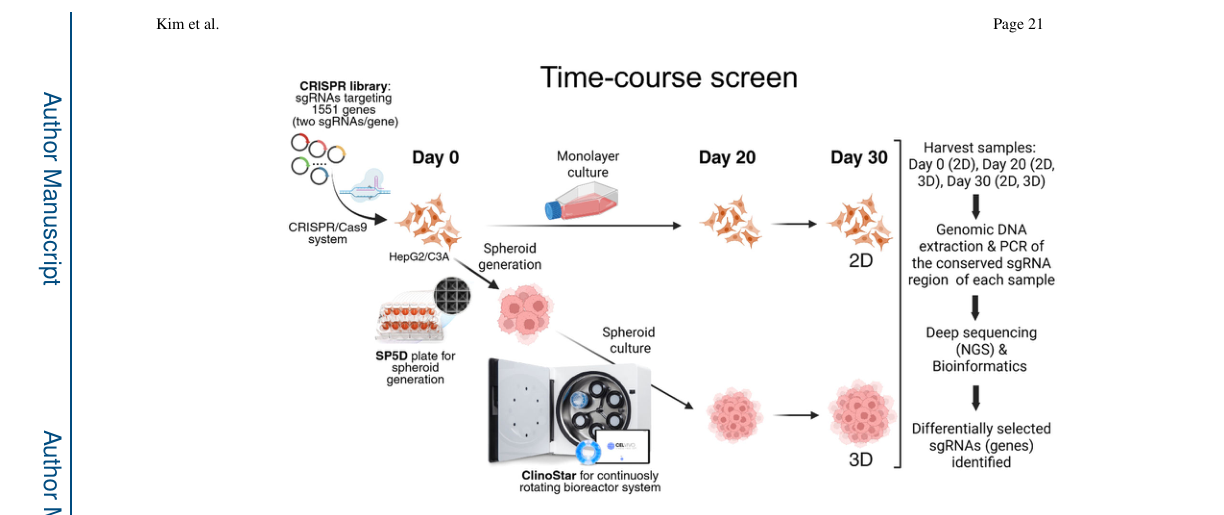
Figure 1. Illustration of the workflow of the time-course 3D CRISPR screening system compared to 2D screening in standard growth conditions. SP5D, Spherical Plate 5D; NGS, next-generation sequencing.
- Fig. 2:Time-course 火山图。Panel A 为 2D 系统,Panel B 为 3D 系统,每个含 Day 20 vs Day 0 + Day 30 vs Day 0 两个火山图。FDR<0.05 + Log2FC <2.5%/>97.5% cutoff;蓝色 depleted,红色 enriched,灰色非显著,黄色 safe harbor
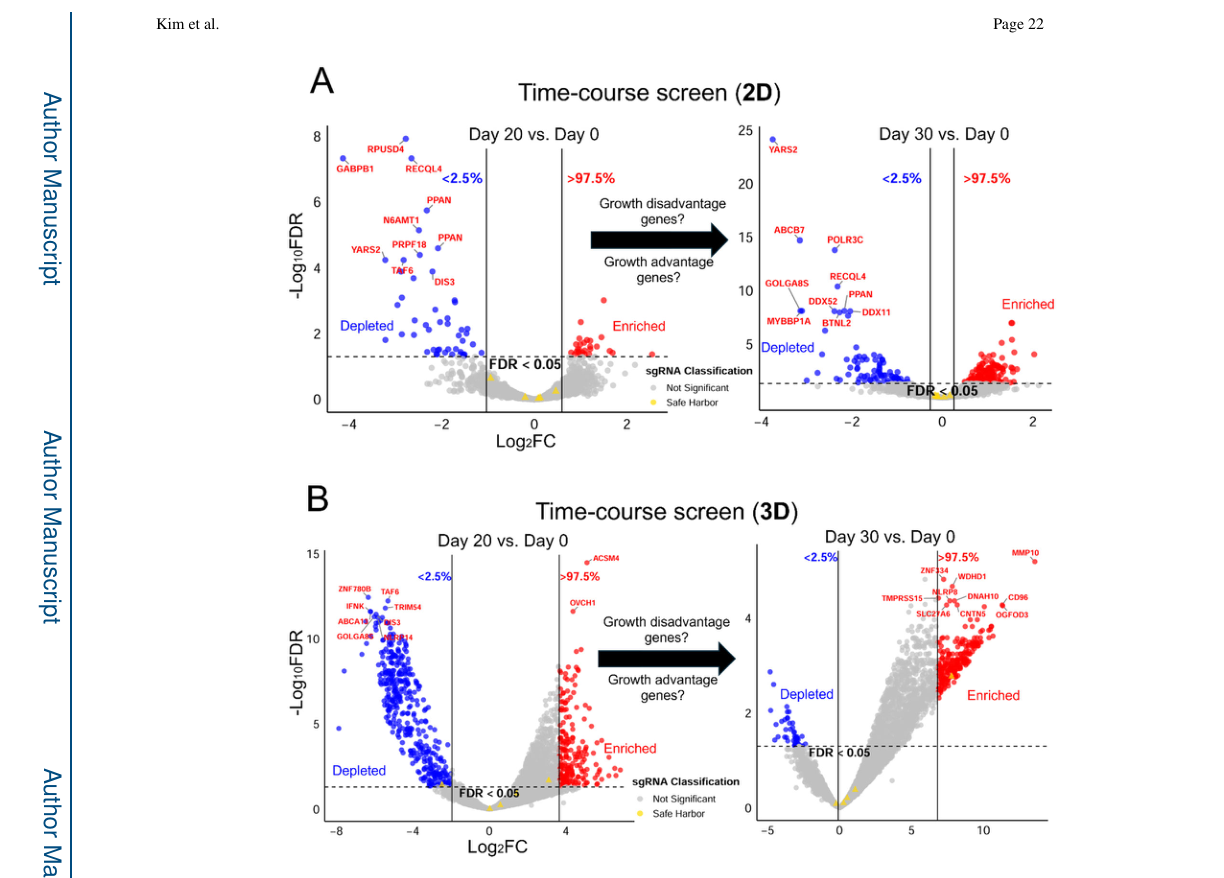
Figure 2. Time-course 3D CRISPR screening system compared to 2D screening in standard growth conditions for each system. Volcano plots show differentially selected candidate genes (depleted in blue; enriched in red) in 2D (A) and 3D (B) time-course CRISPR screens comparing Day 20 vs. Day 0 (left) and Day 30 vs. Day 0 (right). Statistically significant candidate genes (FDR<0.05, and Log2FC <2.5% or >97.5% of empirical distribution cutoff) are labeled in blue (depleted) and red (enriched). sgRNA classification indicates not significant sgRNAs (grey) and safe harbor sgRNAs (yellow).
- Fig. 3:TDE/TDGI 基因分类定义 + 3D TDGI 386 基因的功能富集。Panel A 解释 TDE vs TDGI 分类方法(连续 depletion = TDE;连续 enrichment = TDGI),Panel B 是 386 个 3D TDGI 基因的 GO-CC/KEGG/GO-BP/GO-MP/Reactome 多数据库富集条形图
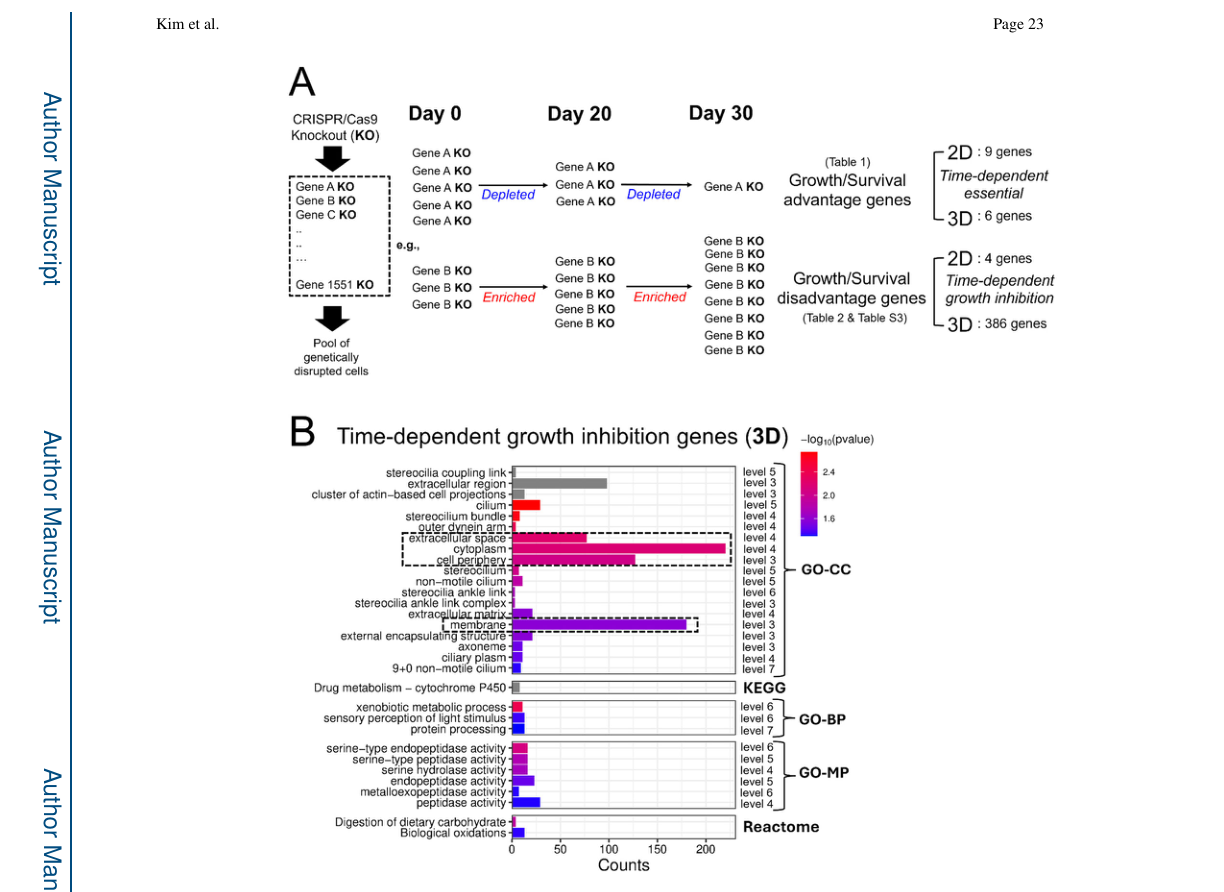
Figure 3. Differentially selected sgRNAs (genes) identified from time-course CRISPR screens of 2D monolayer and 3D spheroid in normal growth media. (A) Illustration of how time-dependent essential (TDE) and time-dependent growth inhibition (TDGI) genes are defined. (B) Functional enrichment of 3D TDGI genes across GO-CC, KEGG, GO-BP, GO-MP, and Reactome databases (top 10 significant terms each; bar color = -log₁₀(p-value), bar length = gene count).
发现 2:3D 系统在 doxorubicin 毒性筛选中显著优于 2D
| 维度 | 说明 |
|---|---|
| 做了什么 | 用 IC25 doxorubicin 在 2D vs 3D 系统中各跑 14 天 CRISPR 筛选,鉴定 Doxo 敏感/耐药基因 |
| 发现什么 | 2D 系统:41 个敏感基因 + 19 个耐药基因(合计 60 个) 3D 系统:91 个敏感基因 + 657 个耐药基因(合计 748 个,约为 2D 的 12.5×) 两组共有候选基因仅 30 个(2D 特有 30 个,3D 特有 718 个) 3D 特有基因 STRING 网络:富集到 ribosome biogenesis 通路 |
| 说明什么 | 2D 和 3D 系统鉴定的遗传调控因子几乎不重叠——3D 球体的细胞微环境、药物渗透梯度、球体内部缺氧/营养梯度揭示了 2D 完全无法复现的耐药机制(ribosome biogenesis 通路说明 3D 球体在长期 doxorubicin 压力下触发核糖体生物合成适应性反应) |
配图说明(Fig. 4-5):
- Fig. 4:Doxorubicin 毒性 3D CRISPR 筛选工作流。CRISPR/Cas9 HepG2/C3A 突变细胞池 → 分 2D(Day 0 加 IC25 Doxo → Day 14 收集)和 3D(Day 0 加药 → Day 6 Accutase 消化 → 重新成球 → Day 8 二次加药 → Day 14 收集)两条路径 → gDNA 提取 → sgRNA PCR → NGS → 差异富集 sgRNA 鉴定
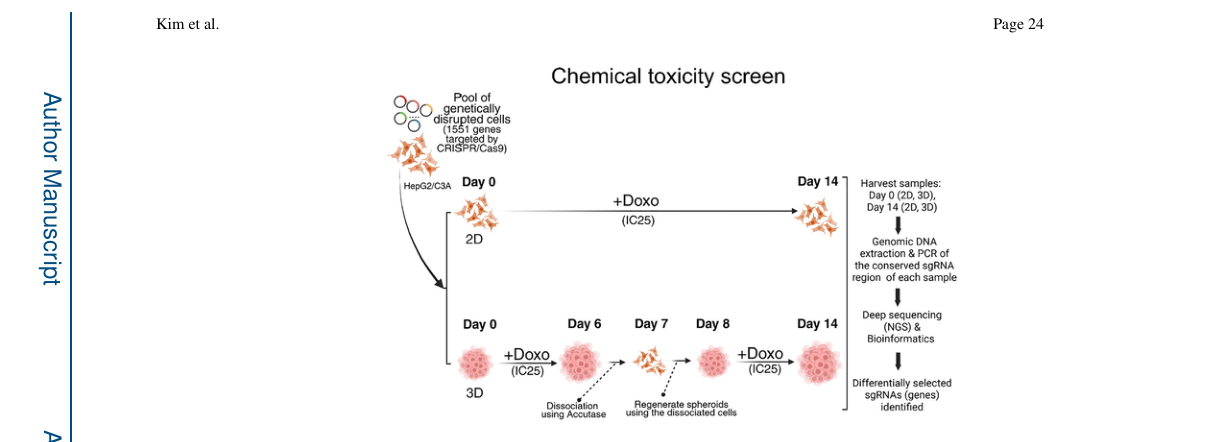
Figure 4. Application of the 3D CRISPR screening system to a chemical toxicity study using doxorubicin (Doxo) as a model chemical. Schematic workflow of the 3D CRISPR screening system for Doxo-induced chemical toxicity screen compared to the 2D system. IC25, inhibitory concentration of 25, where a 25% reduction in cell viability endpoints compared to the control is observed.
- Fig. 5:2D vs 3D Doxo 筛选火山图 + 韦恩图 + STRING 共有网络。Panel A 是 2D 火山图,Panel B 是 3D 火山图,Panel C 是 2D/3D 候选基因的韦恩图(共有 30 个 / 2D 特有 30 个 / 3D 特有 718 个)+ 共有基因 STRING 蛋白互作网络(富集 ribosome biogenesis 通路)
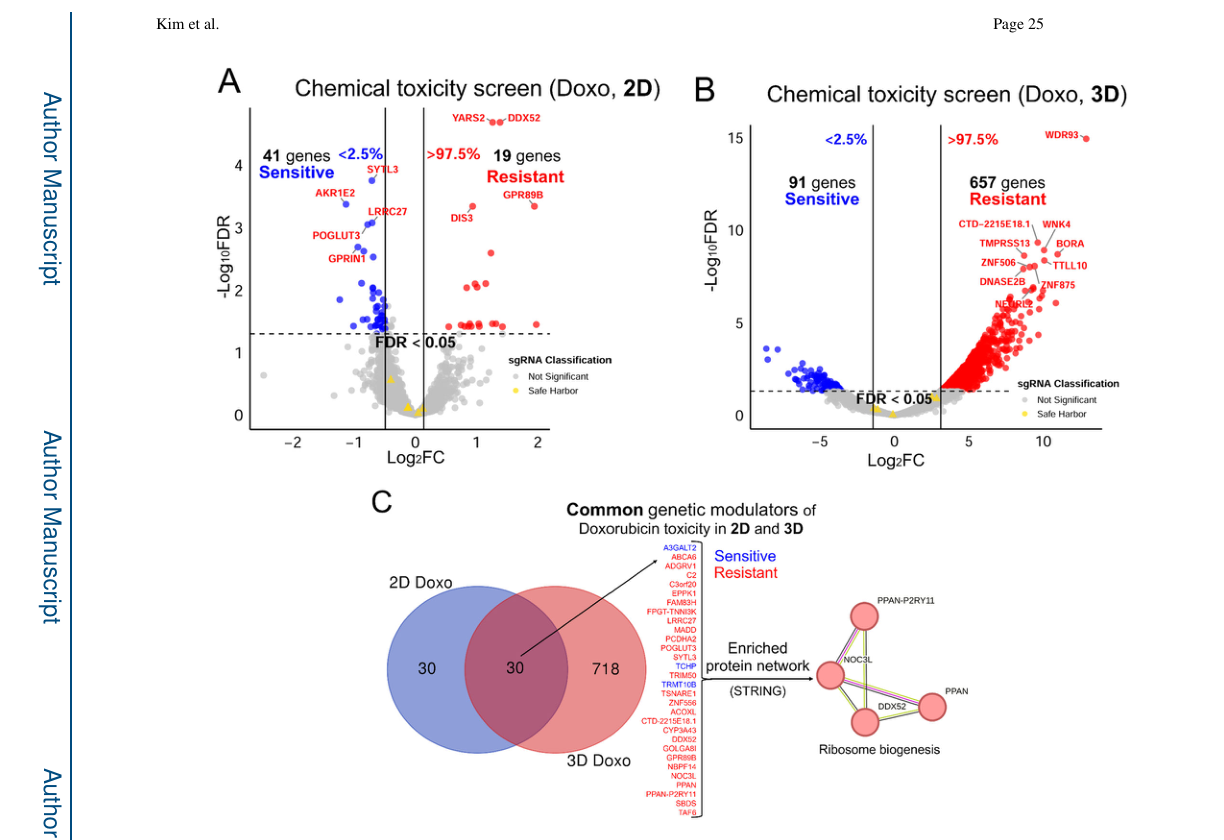
Figure 5. 3D CRISPR screening system to a chemical toxicity study using doxorubicin (Doxo) as a model chemical. (A) A volcano plot of 2D Doxo CRISPR screens identifies candidate genes that, when disrupted, result in increased Doxo sensitivity (blue dots) or increased Doxo resistance (red dots) in the CRISPR screens. (B) A volcano plot of 3D Doxo CRISPR screens displays Doxo-sensitive (blue dots) and Doxo-resistant (red dots) candidate genes identified in the screens. The top 10 statistically significant candidate genes (FDR<0.05, and Log2FC <2.5% or >97.5% of empirical distribution cutoff) are labeled. (C) Venn diagram comparison + STRING protein interaction network of shared candidate genes (n=30) between 2D and 3D Doxo screens.
发现 3:3D 特有 Doxo 候选基因富集 DNA 损伤应答通路
| 维度 | 说明 |
|---|---|
| 做了什么 | KEGG 通路富集分析 2D/3D Doxo 敏感/耐药基因各 4 组(2D 敏感/2D 耐药/3D 敏感/3D 耐药) |
| 发现什么 | 3D 特有候选基因显著富集 DNA 损伤应答相关通路(Reactome/KEGG/GO-BP):Fanconi anemia pathway、DNA repair、homologous recombination-mediated DSB repair、DNA-templated replication、interstrand cross-link repair、replication fork processing 3D STRING 网络(仅 3D 命中):6 个 DNA 损伤修复蛋白节点(FANCM、GEN1、RECQL、POLN、FANCA、RAD54L),核心节点 FANCM 与 FANCA 互作置信度最高 |
| 说明什么 | 3D 球体在 Doxo 长期压力下触发的 DNA 损伤应答机制(DNA 修复 + Fanconi anemia 通路)是 2D 单层无法捕捉的,因为 2D 中 Doxo 主要通过拓扑异构酶 II 抑制触发即时 DNA 损伤,而 3D 球体内部细胞因缺氧/营养限制进入更复杂的应激状态,激活更完整的 DNA 损伤修复网络 |
配图说明(Fig. 6-7):
- Fig. 6:KEGG 通路富集气泡图。Panel A 是 2D 敏感、Panel B 是 2D 耐药、Panel C 是 3D 敏感、Panel D 是 3D 耐药。虚线框标 DNA damage-response 相关通路
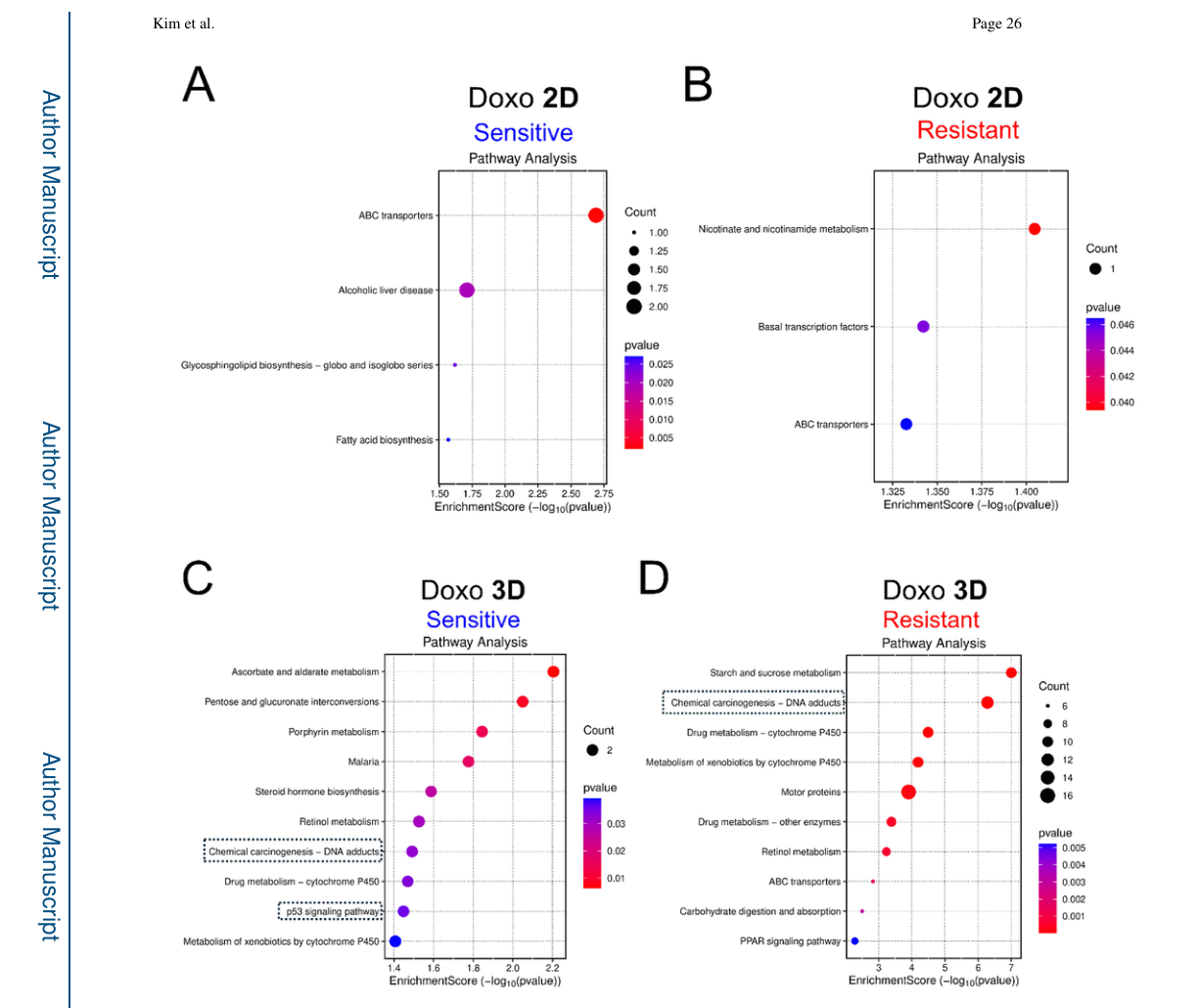
Figure 6. KEGG pathway enrichment of candidate genes modulating doxorubicin (Doxo)-induced cellular toxicity identified in 2D (A and B) and 3D (C and D) CRISPR screens. Results of the Doxo-sensitive genes are displayed with blue headers (A and C), while the resistant ones are displayed with red headers (B and D). Each plot presents the enrichment score on the x-axis while KEGG pathway terms (top 10 significant) are displayed along the y-axis. The size and color of the dots corresponding to the gene count and p-values, respectively. The dashed boxes indicate the terms directly related to DNA damage-response.
- Fig. 7:3D 特有 STRING 蛋白互作网络 + DNA 损伤应答功能富集。Panel A 是 STRING 6 节点网络(FANCM/GEN1/RECQL/POLN/FANCA/RAD54L),Panel B 是 Reactome/KEGG/GO-BP 富集气泡图(Fanconi anemia/DNA repair/HR-DSB repair/DNA-templated replication/interstrand cross-link repair/replication fork processing)
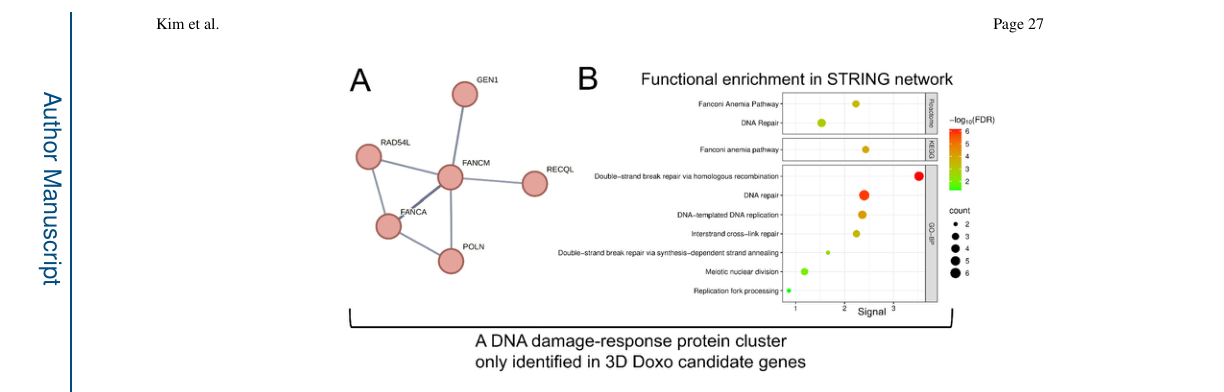
Figure 7. DNA damage response-related functional protein network significantly enriched in 3D doxorubicin (Doxo) candidate genes. (A) STRING protein network identified only in candidate genes of 3D Doxo CRISPR screens, not in the 2D screens. (B) Functional enrichment results reveal specific biological pathways related to DNA damage-response, including Reactome, KEGG, and GO-BP terms.
发现 4:3D 候选基因与 ClinPGx 临床药物基因组数据库的匹配度 7× 优于 2D
| 维度 | 说明 |
|---|---|
| 做了什么 | 将 2D/3D Doxo 候选基因与 ClinPGx 数据库中 4 个蒽环类药物(doxorubicin/daunorubicin/epirubicin/idarubicin)的 282 个基因-变异临床表型关联做比对 |
| 发现什么 | 2D 候选基因仅 1 个(CBR3,9 个变异关联)在 ClinPGx 命中(命中率 0.35%) 3D 候选基因 7 个命中 ClinPGx:ABCC2(10 关联)、ALDH3A1(1)、ATM(2)、CYP2C19(6)、GCKR(2)、GPR35(1)、HMMR(3)(命中率 2.48%,较 2D 提升 7×) |
| 说明什么 | 3D 系统的预测力与临床转化能力远超 2D——这是 3D CRISPR 筛选作为 NAMs 工具的最强证据。3D 球体在 Doxo 毒性机制研究中比 2D 更接近人体真实应答,因此能鉴定出更多已被临床验证的药物-基因关联 |
配图说明(Fig. 8):
- Fig. 8:ClinPGx 匹配分析。3 步骤展示(Manhattan plot 定位染色体关联区域 → 变异-基因表型关联表 → 2D/3D 候选基因与 ClinPGx 比对结果):2D 命中 CBR3(9 关联),3D 命中 ABCC2/ALDH3A1/ATM/CYP2C19/GCKR/GPR35/HMMR
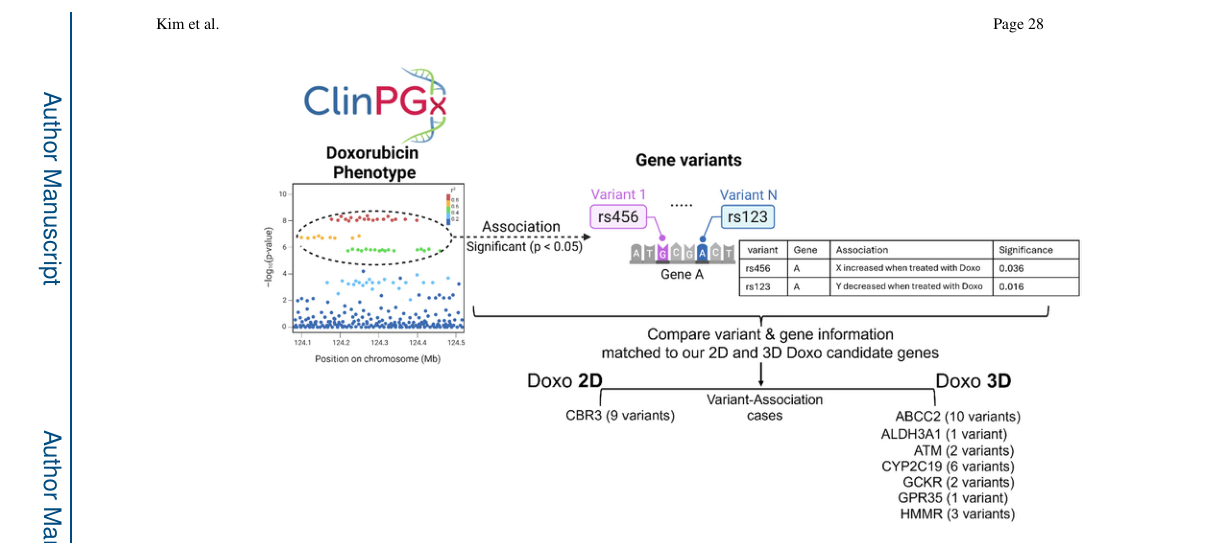
Figure 8. Comparison of candidate genetic modulators identified in 3D and 2D doxorubicin (Doxo) CRISPR screens with ClinPGx-reported gene–variant associations. Candidate genes identified in the 3D and 2D Doxo CRISPR screens were compared with genes and genetic variants previously associated with Doxo-related phenotypes using the ClinPGx database. The database was queried for four anthracycline drugs—doxorubicin, daunorubicin, epirubicin, and idarubicin—to capture a broad set of clinically relevant DNA damage–inducing phenotypes. Detailed information on individual variants, corresponding genes, associated phenotypes, and statistical significance values is provided in Table S4.
💡 与可应用的产品/平台
按本论文直接使用、可迁移互补、客户刚需、代理差异 4 维评分。
| 产品/平台 | 论文使用情况 | 业务对接 | 关联度 |
|---|---|---|---|
| Celvivo ClinoStar 旋转生物反应器 | 直接使用(Section 2.1 Methods,"ClinoReactors and ClinoStar (Celvivo) were used to generate and maintain HepG2/C3A spheroids under a continuously rotating bioreactor system for up to 30 days") | 客户刚需 3D 球体培养 + 30 天长期稳定 + 500× 文库代表性 = 学术/工业客户做 CRISPR 筛选的核心硬件 | ⭐⭐⭐⭐⭐ |
| Celvivo ClinoReactor | 直接使用(与 ClinoStar 同 Section 2.1 提到) | 单球体/小规模 3D 培养,与 ClinoStar 互补(前者高通量筛选、后者单球体精细研究) | ⭐⭐⭐⭐⭐ |
| Celvivo ClinoStar 在 NAMs 监管申报中的潜力 | 本论文明确支持 NAMs 框架("the recent shift toward reducing animal testing under the framework of new approach methodologies (NAMs)") | 监管(FDA/EMA/OECD)推动减少动物试验 + 3D CRISPR 筛选作为 NAMs 工具 = 法规驱动型新增长 | ⭐⭐⭐⭐⭐ |
| 本论文 sgRNA 文库(gnomAD V3.0 LoF 变异 ~1551 基因) | 自定义 | 客户做毒理基因组学/药物基因组学的现成工具,可拓展到更多药物/化合物 | ⭐⭐⭐⭐ |
关键 insight:本文核心是 ClinoStar 30 天长期支撑 3D 球体 CRISPR 筛选的稳定性 + 临床转化能力证明 — Celvivo 设备在 3D CRISPR 筛选/毒理基因组学 NAMs 应用方向有标杆级背书。客户对接可直接引用本文作为"3D CRISPR + ClinoStar = 临床相关 NAMs 工具"的实证。
🏷️ 结论
- 3D ClinoStar 球体 30 天 CRISPR 筛选可行且稳定:本论文证实 ClinoStar 旋转生物反应器可在维持 500× 文库代表性条件下支撑 HepG2/C3A 球体 30 天连续培养,且 sgRNA 丰度可通过 NGS 可靠量化。
- 3D vs 2D 遗传谱系几乎不重叠:time-course 生长筛选中 2D 鉴定 4 个 TDGI 基因、3D 鉴定 386 个(95× 差异);Doxo 毒性筛选中 2D 与 3D 共有候选基因仅 30 个(3D 特有 718 个),揭示 2D 单层完全无法复现的 3D 微环境调控机制。
- 3D 球体触发 2D 缺失的 DNA 损伤应答网络:3D 特有 Doxo 候选基因显著富集 Fanconi anemia、HR-DSB repair、interstrand cross-link repair 等 DNA 损伤修复通路(STRING 网络 6 节点:FANCM/GEN1/RECQL/POLN/FANCA/RAD54L),这是 3D 球体在长期 Doxo 压力下独有的应激反应。
- 3D 系统的临床转化力 7× 优于 2D:与 ClinPGx 数据库 282 个临床基因-变异关联比对,2D 仅命中 1 个基因(CBR3,命中率 0.35%),3D 命中 7 个基因(ABCC2/ALDH3A1/ATM/CYP2C19/GCKR/GPR35/HMMR,命中率 2.48%)。
- 3D CRISPR 筛选是 NAMs 框架下的优选工具:在 FDA/EMA/OECD 推动减少动物试验的监管背景下,本研究为机制导向的体外功能毒理基因组学提供了完整的 3D 解决方案(ClinoStar 硬件 + CRISPR 文库 + 生信流程 + ClinPGx 验证),可直接被工业客户用于药物安全性早期评估。
📖 文献信息
- Title: Physiologically relevant 3D CRISPR screening enhances mechanistic insight into chemical toxicity compared to 2D screening
- Authors: Chanhee Kim, Zhaohan Zhu, Abderrahmane Tagmount, W. Brad Barbazuk, Rhonda Bacher, Christopher D. Vulpe
- Affiliation: Center for Human and Environmental Toxicology, Department of Physiological Sciences, College of Veterinary Medicine, University of Florida, Gainesville, FL, United States
- Journal: Toxicology (Elsevier)
- Year: 2026
- Volume/Issue: S0300-483X(26)00029-6
- DOI: 10.1016/j.tox.2026.154422
- PMID: 41643803
- PMC ID: PMC13185028
- Impact Factor: 4.8 (Toxicology, 2024)
- Open Access: CC BY license
- Keywords: functional toxicogenomics; 3D CRISPR screening; NAMs; Spheroid; Genetic variability; Chemical toxicity; Doxorubicin; Anthracyclines
📥 原文 PDF 下载
| 文件 | 下载链接 |
|---|---|
| Kim 2026 Toxicology 3D CRISPR Screening PDF (2.2 MB) | 下载 |
转发语: Kim 2026 这篇是 ClinoStar 3D CRISPR 筛选的"标杆论文"——30 天稳定培养、386 个 TDGI 基因(2D 仅 4 个,差 95×)、ClinPGx 临床匹配 7× 优于 2D。对 Celvivo 设备在 NAMs 毒理基因组学应用方向有强背书 🧠⚡
联系人:李东伟|📞 18045130660|🌐 https://www.biokingdom.top